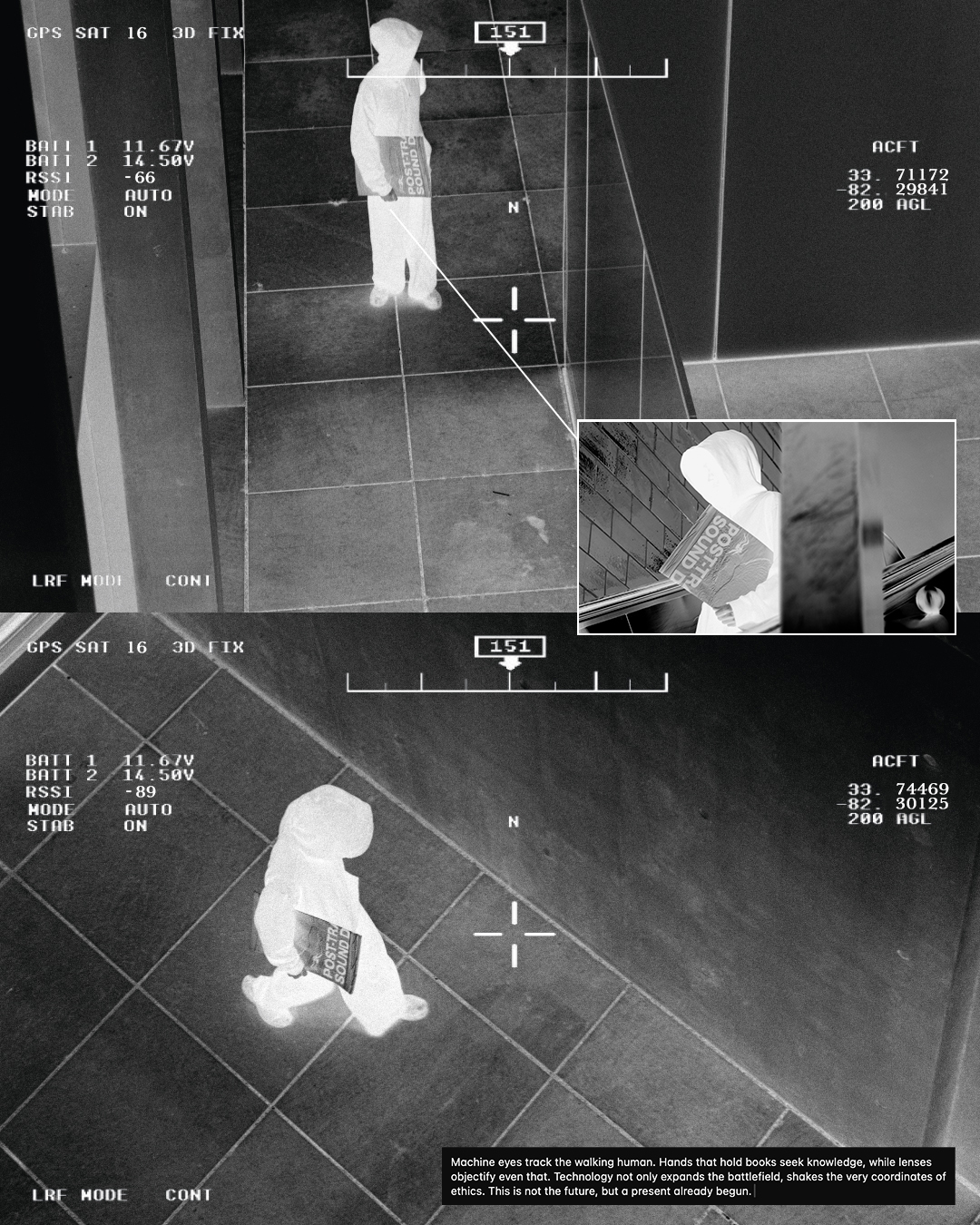
“PTSD: Post-Traumatic Sound Disorder” is an ongoing project – within our broader research on Cognitive Warfare – exploring how the brain has become the new battlefield. Positioned within the evolving discourse of Cognitive Warfare, the project examines how contemporary conflict operates not only through kinetic violence but increasingly through neuroweapons: tools designed to manipulate, destabilize, or directly assault cognitive and perceptual systems. This work investigates the psychological and physiological impact of sound in modern conflict, with a focus on FPV (First-Person View) drones. These small, agile drones, often equipped with explosives, emit a distinctive high-frequency buzz that has become synonymous with imminent death on the battlefield. This sonic signature has not only transformed military tactics but also introduced a new kind of trauma: anticipatory PTSD, triggered by auditory cues alone. The sound of a drone, once a symbol of play or surveillance, now carries the weight of lethal intent. This project frames that acoustic trace as a form of mental assault: a post-traumatic sound disorder. Drawing from open-source drone warfare footage, field reports, and speculative neurodesign practices, the project unfolds through soundscapes, visual systems, and cognitive mappings that refuse to engage in geopolitics or moral binaries. It is not about right or wrong, winners or losers. It is about how the human nervous system is increasingly pulled into the logic of war through interface design, gamification, and sensory manipulation.